
What is a sales performance audit?
A sales performance audit is the critical first step of the journey towards sales optimisation and then sales growth.
If sales improvement is your aim then it can’t start until you fully understand why you’re getting the sales results you are.
Once you have that information, then you can easily / quickly start to make the changes to get higher sales, margins, conversions and customer orders.
A Morton Kyle Sales Insight Audit is a high impact / low risk sales performance improvement route, and part of the S.A.V.E.R. Sales Growth Engine
The initial goal for any organisation is to create a stable, repeatable, predictable sales output, then to introduce high performance sales strategies to move from sales optimisation to sales maximisation…and then adopt continuous sales improvement.
This article on the 21 stages in a sales performance audit is for you in you want to move through those 3 critical phases easily and quickly, building momentum so that any sales improvements are sustainable.
Plus – if you want to take your people with you along on journey without resistance or change fatigue by conveying ownership, responsibility and accountability, then your sales performance audit results will give you ample narrative to energise even the toughest sales functions!
Please note: I talk about sales improvement audit and sales performance audit interchangeably….for the purpose of this, you can think if them as one and the same.
Why is a Sales Performance Audit Valuable?
How many reasons do you need?
According to the leadership functions I work with, they typically find 2 or 3 reasons, mainly driven by:
- Seeking revenue growth and revenue stability
- Ensuring efficiency/effectiveness within the sales function in terms of conversions, pricing, positioning
- Boosting sales velocity
- Creating a precursor to scaling
As well as building a sales function that supports
- Better planning
- More accurate sales forecasting
- Removing costly sales leaks
- Reducing / optimising costs
- Supporting increased revenues without increased head counts
And then some CEOs and Sales Leaders look to a sales performance audit driven by other, more broader, business needs. The sales performance audit becomes less about revenue and more about broader business benefits including:
- Getting ready to sell the business
- Wanting to access funding
- Needing a new data driven sales improvement plan for the bank / investors
- Introducing new pricing / value positioning
- Capitalise on a market opportunity
- Marrying the sales plan with the sales strategy
- Re-organising the sales function in preparation for scaling the business
Your Sales Performance Audit – Your Key to High Payback, Low-Risk Sales Growth
I’ve been doing sales audits for over 20 years, and the results ( and subsequent actions post audit) are now more relevant than ever.
Because today, we are in the era of
- Doing more with less
- Competition swoops in faster as buyers are more likely to shop around, and barriers to entry into lots of industries are low
- Customer loyalty is low, and their demands high
- Staff turnover is high, and recruitment an ongoing challenge
- Costs associated with doing business are increasing everyday
- Increasing headcount is too risky and costly
- Throwing more money at marketing is equally risky and even more costly
- Margin are shrinking
A sales performance audit ensures the senior leadership team have all the information they need to make the right decisions, at the right time, based on fact not opinions or fiction.
To the savvy CEO and Sales Leader the sales performance audit output becomes THE mission control foundation for predictable sales outputs, scaling the business, solid revenue, safe margins.
The Sales Performance Audit | 21 Steps
Here we’re covering the 21 stages of a sales performance audit, sharing a brief summary of what happens at every stage and hopefully giving you food for thought in terms of establishing whether your organisation will benefit from taking your sales (and maybe marketing) function through such a process.
Note: You Sales Performance Audit is Bespoke to Your Business
As you read through – understand this – there are different types of Sales Performance Audits depending on what you’re looking to achieve.
Whilst many of the stages are generic, bespoke sales performance audits are created by default as the audit becomes more granular based on the findings from each stage. Your sales performance audit is each audit is tailored to your specific business goals and will generate specific information specific to your needs.
The 21 Critical Stages of a Sales Improvement / Sales Performance Audit
Stage 0: What to do to make sure your sales performance audit is a success
Positioned wrongly, a sales performance audit can cause confusion and resentment.
That’s why we take great care in explaining that any sales performance audit is designed to give everyone the insight, wisdom, skills and pathways to understand and improve the sales process and sales results from their perspective.
It’s not about apportioning blame, it’s not looking for anything other than a route to efficiency, effectiveness and growth in the sales function. To support this, we share everything we find – there are no shadows in this process, we also welcome robust conversations around data, data collection, methodology, data interpretation and usage.
Stage 1: Initial Assessment
This is one of the critical heuristic parts of the sales performance audit process, and speaks directly to the section above
It starts with a meeting of key stakeholders at all levels within the sales function to get multiple points of view.
Some of the things we might cover are:
- Sales blockers / challenges
- Competitive landscape
- The evolution of the sales function
- Goals, aspirations and ambitions
- The potential within the sales function
- Sales and market alignment
- Reward and recognition
- Sales strategy
- Activity levels
- Culture and management styles
- Recruitment and retention
- Performance to date against targets, and associated trends
- Value proposition
This is a very simple, high level list.
Basically the purpose of this stage is to collect and share relevant information that will give context to the sales performance audit.
The more detailed and honest this part of the process, then the deeper the analysis can go, which often leads to higher quality sales improvement interventions.
Stage 2-4: Sales Analysis from Lead to Order
Here we analyse each stage of the sales process from creation/generation of a lead through to close (and sometimes through to invoice and money collection)
This covers
Sales process analysis
Use Sales Process Analysis – to uncover leaks in the sales process from sales lead generation to order signed
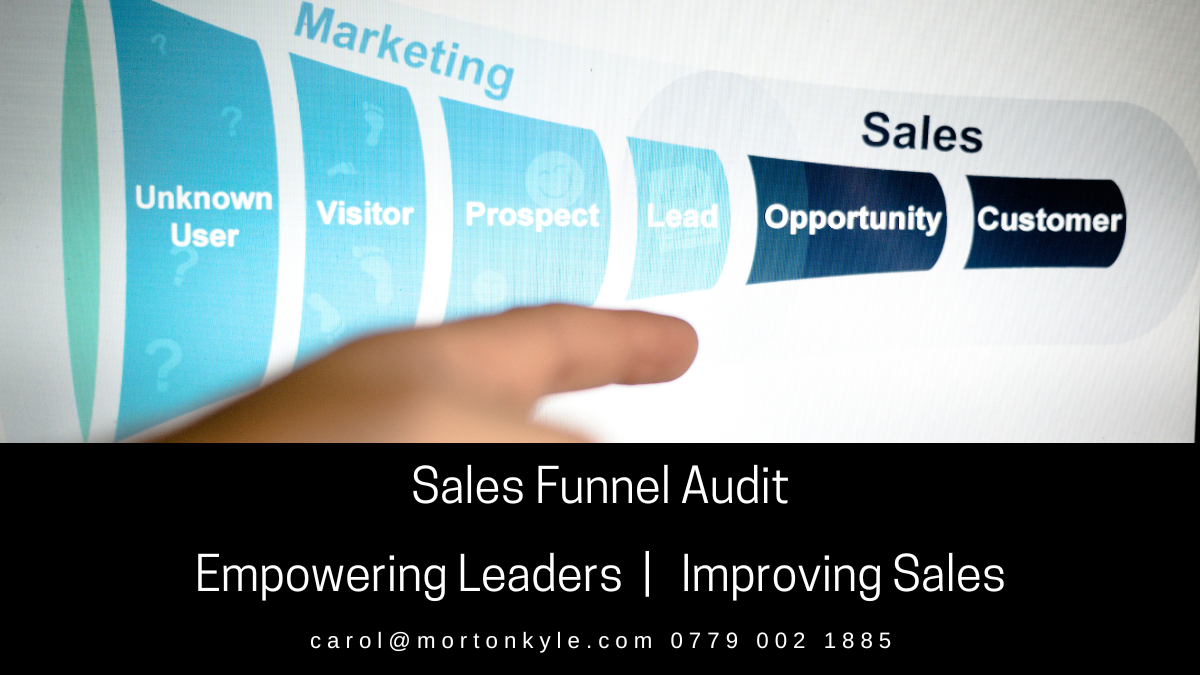
Sales funnel analysis
Use Sales Funnel Analysis to explore the flow of orders (money) through the sales (and potentially marketing) function
Sales pipeline analysis
Use Sales Pipeline Analysis to explore friction points, untapped revenue, skill set, market fit and a myriad of other things around sales forecasting and growth potential
Customer acquisition
Customer Acquisition because each sales lead channel will have a very specific set of metrics
CRM analysis
CRM Analysis shows whether you’re using the CRM in the best way to support the sales function – is it a dumping ground or the sales pump that squeezes sales orders through?
Sales Forecasting
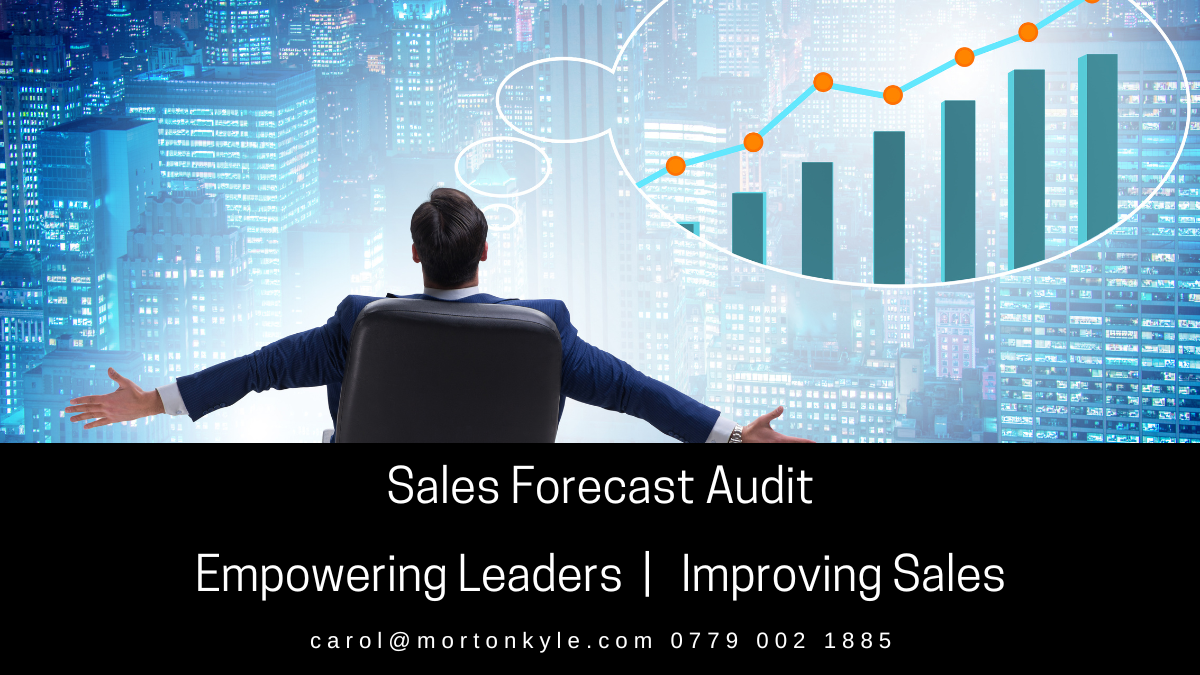
Since this is often a tough area, but a critical one, we seek to understand where data is pulled from and how it is tested for robustness. Fixing poor sales forecasting is a key element of any sales performance audit
Stage 5-7: Sales Data Collection and Analysis
As you can imagine – the audit stages above generate a tonne of data, it’s important to not just make sense of this data but to also sense check the findings, conclusions and outputs with key stakeholders at all levels.
This allows for robust discussions, some lightbulb moments and a sense of conferring knowledge, skills and ownership from our team to yours.
During this stage, as we progress the data analysis, we’ll be conducting ongoing 121 and team meetings to discuss our findings in terms of:
- Sales Optimisation
- Revenue potential unconverted
- Revenue growth
- Sales funnel optimisation
- Sales pipeline optimisation
- Sales process optimisation
- Sales friction points
- Sales forecasting
- CRM analysis use and abuse
- Sales and marketing alignment
As with any audit work – rubbish in = rubbish out so we are always keen to use this part of the process to start the knowledge transfer part of the work, and also to ensure our clients understand where we have pulled data from, how we’re using it and how it can help them to migrate towards higher levels of growth after we’ve completed the audit.
Some clients will also use this part of the process as the start of them developing their own internal sales trouble-shooters and sales performance improvement specialists
Stage 8-10: Sales Team (and maybe Marketing Team) Assessment
In this section we look at the people resources devoted to the sales (and potentially marketing) functions
Based on, and using the information collected above, we systematically analyse the impact of the current skill set, sales mindset, motivation, habits, behaviours, ways of working and tools on the results that are currently being achieved.
We also look at individual sales results in order to identify best practice, sales excellence and growth opportunities via different kinds of training from product to skill. Market awareness and competitor insights.
This is a delicate stage as we seek to understand people.
We mitigate this by ensuring all parties are involved at all stages.
This analysis is done ‘with’ your people and not ‘to’ them…many see it as an opportunity for personal growth and development.
Typically this sales team analysis takes place at all levels as the organisation sees fit.
Stage 11-13: Customer and Competitor Analysis
This part of the sales performance audit takes on a number of guises but essentially looking at where your organisation, products, service and value propositions including messaging and pricing are making it easy for your competitors to secure orders you should be winning.
This section alone is very potent. One client was able to triple their average order value in 6 weeks just by getting to grips with this section of the audit!
Understanding your customers, competitors and where you sit in relation to both is a critical eye opener for many executive teams.
It often energises the sales and marketing functions, and brings about much needed critical sales and marketing alignment, when they realise where their fit is now and where it should and could be, and the resulting potential increase in performance.
Stage 14-16: Strategy Development
This is where we start to bring together our findings, and build out some loose models based on our sales analysis, discussions, and insights to date.
Depending on the client remit we may look at specific heading for this, either as single sales improvement drives like:
- Competitor demise
- Pricing – increase average order values, average spend and lifetime value
- Conversions rates from lead to order
- Reducing customer churn
- Building strong up selling / cross-selling channels
- Lead generation
- Sales forecasting accuracy
- Sales pipeline management
Or very specific areas of improvement like:
- Developing a last year + 20% growth model
- Building balanced scorecards and sales management information dashboards to help drive daily sales performance
- Introducing a culture of Continuous Sales Improvement and Positive Performance Management
These are just examples and vary depending on the specific client need and remit.
Stage 17-19: Implementation and Monitoring
Closely aligned to the above, this is where we draw up action plans. Based on the findings from the sales performance audit we begin creating ‘Fast Action Pack – 30 Day Actions’ for the internal team, to help them on the implementation journey.
It also feeds the short (3 month), mid (6 month) and long(12 month) action plans.
All these are subsequently presented to the respective parties via workshops. Workshops are used to drive ownership, acceptance and responsibility for execution.
It’s rare that our action plans come out of these meetings fully intact.
And that makes us really happy.
Happy because we know the leadership teams have used our foundation to mould it into something they can take ownership and accountability for delivering. Fully furnished with the understanding and appreciation of WHY they need to make the changes and HOW best to do that
The sales performance audit findings becomes the business ‘document of truth’ and the benchmark the organisation uses to drive ongoing engagement and ensure continuous monitoring and improvement
Stage 20: Continuous Improvement
Because every sales performance audit and sales improvement audit comes with performance / management information dashboards and balanced score cards, then every strategy is set up to support continuous sales improvement.
No organisation acts as an island. One of our guiding principles is that during your sales performance audit we take care to transfer the knowledge from our team to yours.
This is important to us so that you can maintain the work practices to support you and your executive team in keeping you, firstly, ahead of your competitors, and secondly, making the most from your sales and marketing investment.
The impact of a good sales performance audit is that it should introduce ways of working that become embedded in the DNA of your culture.
Sales Improvement Audit | Summary and Caveats
This is, in one way a whistle stop overview, and in another more detailed than it should be…but I wanted to give you context.
Your sales performance audit / sales improvement audit can be exactly what you want it to be. It will cover what you think are the key issues you’d like to solve.
In fact, one of the very first questions we’ll explore when we speak is – what’s happening in your sales team at the moment that you’d like to change?
It’s a powerful list to draw up – and an even more powerful list to unpack.
So, in case you were thinking that there is a one size fits all framework for this then – fear not – you get to pick exactly what you want!
Could Your Organisation Benefit from Taking a Sales Performance Audit?
Here are just a few signs you might be ready to take the first step towards fully understanding how your sales (and marketing) function could work better and at a higher output:
Maybe you’re seeing:
- Competitor entry and growth
- Margins being eroded
- Conversion rates dropping
- Unstable sales outputs
- An inability to accurately forecast for the bank / investors / funders
- Increase headcounts and costs but no uplift in sales revenue or margins
- Lack of daily visibility on sales performance
- The same old accounts popping up month in month out
- Swollen and stuck sales pipelines
- A CRM that looks like a dumping group rather than the engine in your sales function
- A disconnect between sales and marketing
- Increased marketing spend with poor returns
If you’re experiencing any (or all) of these, then maybe it’s time to book in a call to discuss your options?
To see how your organisation can benefit from an audit of your sales function, call Carol on 0779 002 1885.
You’re in Control – Select Your Bespoke Sales Performance Audit
A sales performance audit is the quickest and smartest way to uncover the potential in your sales function…so if you have sales ambitions that are higher than your current sales outputs then let’s talk about how a sales performance audit can help your organisation to thrive….
And remember:
No one size fits all solution when it comes to your sales performance audit.
You can select just what type of sales performance audit you want – here’s the start of a check list to help you decide what’s top of your wish list for your sales function:
- Sales performance optimization
- Sales performance improvement
- Function / Team capability audit – Sales and / or Marketing
- Business Generation / Sales process analysis
- Sales strategy assessment
- Revenue growth
- Funnel optimization
- Pipeline analysis
- Customer acquisition audit
- Lead generation audit
- Channel audit
- CRM analysis and audit
- Sales data analysis
- Sales forecasting
- Competitor analysis
- Pricing strategy audit
- Sales training evaluation
- Marketing alignment audit
Ready to Fix Your Sales Performance?
Arrange a Free Sales Consultation – discuss your challenges & growth goals
Stop leaving revenue on the table. Take the first step today, use the link to book a call and discover how our sales performance audit can help you achieve your sales revenue and margin goals this year.

Hi, welcome to Morton Kyle Limited.
Morton Kyle is a UK-based B2B sales improvement consultancy that helps CEOs and Sales Directors fix underperforming sales teams, improve forecast accuracy, and scale predictable revenue growth, as Founder and Lead Consultant, I’ve spent the last 30+ years in the sales trenches with global brands, challenger firms, and fast-growth sales teams to:
✔ Fix underperforming pipelines – turning leads into closed deals, systematically and predictably
✔ Increase win rates -through optimised sales processes, building first-class value propositions, and sales best practice
✔ Build sales systems that actually work – and deliver cash in the bank
I’m not another ‘sales trainer.’ I don’t teach theory. I fix sales problems – fast. And if you’re still reading, it means you’ve got a problem that needs fixing?
I know how sales leaders think because I’ve been one. I know what the board wants because I’ve sat in those meetings.
And I know what works – because I’ve done it, tested it, and proved it across industries, markets, and economic downturns.
Worth a 30 minute call to see if I can help you deliver higher sales in your business?