
After 1000’s of sales audits, across numerous sectors, domestic and global, this is one of the most common questions I get when CEOs and Sales Leaders are stuck and aren’t sure what to do next when faced with a situation where sales performance has stalled:
“Our pipeline is healthy… so why isn’t anything closing?”
If that’s where you are now – and your pipeline is not converting – read on.
We’ve helped CEOs and Sales Leaders just like you…facing mounting pressure, looking at a pipeline not converting, having tried sales training, amended commission plans, tactical discounting, activity drives…and still nothing’s closing.
The struggle is common, real and costly if you wait and hope it gets better without your intervention.
Dealing with melting sales forecasts, re-engaging sales stuck in the later stages, forcing sales cycles that last too long, seeing massive conversion dips, and overall sluggish sales conversions along the sales process is soul destroying but never more so that when…
- Your CRM shows opportunities.
- Your sales team is busy.
- Forecast numbers look promising.
But revenue isn’t landing.
- Deals stall.
- Sales cycles stretch.
- Forecasts miss.
You try everything to kickstart sales flow when your pipeline is not converting:
- Increase activity levels…and your sales team start to be driven by the wrong metrics
- Provide more sales training…it’s just a lost selling day with no sustainable improvement
- Introduce controlled discounting…probably discounting to prospects who would buy anyway
- Enhance commission incentives…paying even more bonus on deals that would have converted, but are now converting at the same rate but with lower margins because you discounted!!!
And still… nothing improves.
At this point most leadership teams reach the same frustrating conclusion:
“We’re clearly missing something … but we don’t know what.”
The truth is that a full pipeline does not guarantee revenue.
In fact, many mid-sized B2B firms suffer from a phenomenon we call pipeline theatre.
Pipeline Theatre: The Illusion of Progress
Pipeline theatre occurs when the sales pipeline appears healthy but lacks structural integrity.
Deals move forward through stages, but not because buyers are progressing.
Instead, deals move forward because:
- Salespeople believe they will close
- Managers want optimistic forecasts
- Opportunities are not rigorously inspected
- Disqualification is avoided
This creates a pipeline filled with hope rather than evidence…which means you’ll see a sales pipeline not converting…
The result?
- Deals stall in later stages
- Sales cycle length increases
- Discounting becomes common
- Forecast accuracy collapses
From the outside, the pipeline looks strong.
From the inside, it is fragile.
A pipeline not converting is an early warning signal to further trouble ahead – so you need to act fast.
Stage Inflation: Why Deals Get “Stuck”
One of the most common causes of pipeline failure is stage inflation.
Stage inflation happens when opportunities advance in the CRM without the buyer making a genuine commitment.
For example:
A deal moves from “Discovery” to “Proposal” because the salesperson believes the prospect is interested.
But the buyer has not yet:
- confirmed budget
- engaged the economic decision maker
- clarified decision criteria
- established urgency
The opportunity appears to be progressing.
But structurally, nothing has changed.
When stage inflation occurs across a pipeline, forecasts become unreliable.
Deals cluster in late stages but fail to close.
This is why so many organisations experience the same pattern:
A large pipeline that delivers little revenue.

Qualification Failures: The Root Cause of Stalled Deals
When sales pipelines fail to convert, qualification is usually the root problem.
Weak qualification creates opportunities that should never have entered the pipeline in the first place.
Typical qualification failures include:
- No confirmed and engaged economic buyer
- Budget assumptions instead of confirmation
- Poor discovery and challenge
- Unclear decision criteria
- Weak commercial urgency
- Limited stakeholder engagement
Without these elements, deals drift. Pipeline conversion stops. Your CRM becomes a holding pen for sales potential….only there’s really nothing there, and there never was.
Salespeople continue pursuing them because:
- Abandoning them feels like failure
- They don’t know what ‘good’ looks like in terms of a fully qualified deal
- And, even if they did they don’t know how to get there
- The sales process, and associated sales metrics that sit alongside that process, are nowhere near granular enough to act as any sort of robust forecasting tool
So, when push comes to shove, the opportunities you’re looking at in Stage 3 never should have been there, and because they lack that commercial integrity, they were never viable.
You were looking at a best case scenario all along.
The pipeline becomes crowded with false positives.
Partly due to the sales function, and partly due to how you structure and report on the sales pipeline and associated sales process and accompanying metrics.
Now, let’s look at some of the source of some of the biggest challenges in dealing with a stalled sales pipeline, where sales are stuck in the final stages, the forecast melts like cream on hot chocolate, and sales conversions are not stable…
The Missing Economic Buyer
One of the most overlooked issues in stalled pipelines is the absence of the economic buyer.
Sales teams often build relationships with operational contacts or technical stakeholders, people who are great champions but not always great internal sales people for your products and services.
So, when the deal reaches commercial negotiation, the real decision maker appears, and the seller realises how ineffectual their champion actually is when it comes to getting the cash out of the budget…
And so, suddenly the deal stalls.
Why?
Because the person with authority over:
- Budget
- Risk
- Value assessment
- Commercial approval
was never involved in the conversation.
Without the economic buyer engaged early, deals frequently collapse at the point of commercial decision, and one of the biggest reasons for ghosting, after all, how can a champion go back to a buyer and state that he/she doesn;t have the internal clout to push a purchase order through?
This is why opportunities that look promising for months can suddenly disappear.
Sales teams in this position cause their own problems!
Yet still, too often, to the average sales rep it’s better to have an overly optimistic sales pipeline than an accurate sales pipeline!
Margin Warning Signs: Discounting as a Symptom
When pipelines stall, sales teams often attempt to revive deals through discounting.
At first, this may appear logical.
- Lower the price.
- Encourage the buyer to move faster.
But discounting rarely fixes stalled deals.
Instead, it creates new problems:
- Margin erosion
- Reduced commercial confidence
- Future price expectations
More importantly, discounting often masks deeper structural issues.
If price is the only lever available to move a deal forward, the value proposition is either unclear or the opportunity was never strong enough. Which is such a shame when building a string value proposition is an easy fix, and creating a situation where the opportunity (or not) is crystal clear is Sales 101!
Discounting does not repair weak qualification.
It simply ACCELERATES the loss.
Why Salespeople Avoid Disqualification
Many stalled pipelines persist because salespeople avoid disqualifying opportunities.
There are several reasons for this:
- Fear of losing pipeline value
- Pressure to maintain optimistic forecasts
- Emotional attachment to deals
- Commission structures rewarding volume over quality
Disqualification feels like failure.
But in reality, disciplined disqualification improves pipeline health dramatically.
A smaller pipeline with genuine opportunities will outperform a larger pipeline filled with weak deals.
The problem is not usually pipeline size.
Pipeline size is the wrong metric to be hanging your professional reputation on if you’re a sales leader or a CEO.
Your primary concern should be, must be, pipeline integrity.
What’s that look like?
It looks like this…how many of the sales lead that I’ve got forecast in this sales pipeline are definitely going to close by X date?
The Role of Sales Manager Inspection in Improving Sales Forecast Accuracy
Many people think pipeline health ultimately depends on management discipline. I disagree.
Pipeline health ultimately sits with the sales team and the individual sales reps.
When a sales team knows what a good sales lead looks like, how to build it, stress test it, explore it and turn it inside out, then the business will have an accurate sales forecast.
Admittedly, sales managers who simply review pipeline value often miss the real issues. But that;s equally because they are looking a symptoms of the problem and applying superficial band aids…
Instead, effective inspection requires examining the evidence behind each opportunity.
Managers should regularly ask:
- Who is the economic buyer?
- What problem has the buyer confirmed?
- What happens if the buyer does nothing?
- What decision process is in place?
- What evidence supports the deal stage?
Without this level of scrutiny, pipeline theatre continues unchecked.
Deals progress through stages without meaningful buyer movement.
Forecast reliability deteriorates.
Revenue remains unpredictable.
So, is this a training issue – no.
Primary your stalled, fat sales forecast that closes sporadically and falls apart more month than it delivers is your que to ask – WHAT ARE WE MISSING TWO LAYERS DOWN?
Introducing the Morton Kyle Fix and Flow Approach to Optimising Sales Performance and Unlocking Sales Growth
At Morton Kyle we frequently work with organisations experiencing exactly this situation:
- A full pipeline.
- Minimal closures.
- Unreliable forecasts.
Our Fix and Flow approach focuses on identifying and repairing structural weaknesses within the sales system, done with you or done for you, this service empowers your team to drive sales performance and repair sales teams that struggle with accurate sales forecasting, deals stalling, sales pipelines that leak during the later stages, overly long sales cycles, fluctuating sales conversion rates, high friction sales processes, and poor qualification and value creation sales pitches.
This 90 Day Sales Sprint includes:
- pipeline integrity analysis
- qualification discipline
- margin protection
- forecasting accuracy
- leadership inspection cadence
You can check out some of the things we cover here – it’s free (for the moment) Fix Your Leaky Sales Pipeline or you call book a call to discuss your current sales challenges
The Morton Kyle Fix and Flow ensures that opportunities progress because buyers are moving forward, and not because salespeople are optimistic.
The S.A.V.E.R Framework: Diagnosing Sales Leaks
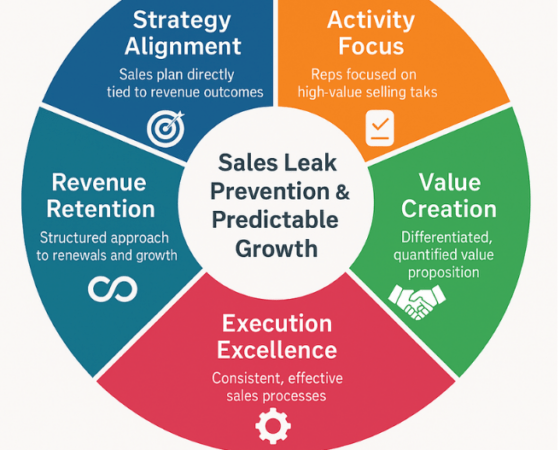
The Fix and Flow approach is powered by the Morton Kyle S.A.V.E.R framework.
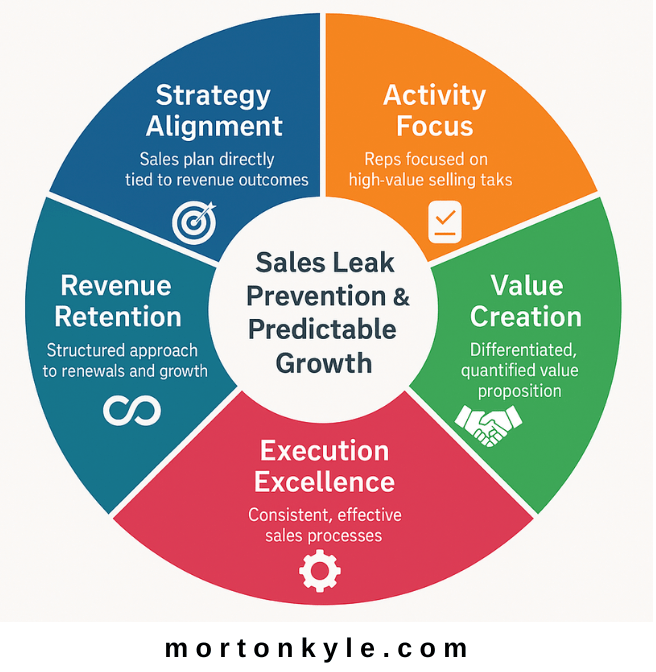
This framework allows leadership teams to see clearly where revenue leakage is occurring.
Instead of guessing why deals stall, they gain data-driven insight.
And once the leaks are visible, they can be fixed.
You can test this for free here – Fix My Leaky Sales Pipeline
Summary: Why Forecasts Become Inaccurate
Forecast inaccuracies are rarely random.
They are usually the result of:
- stage inflation
- weak qualification
- insufficient deal inspection
- emotional probability estimates
Sales teams often assign probability percentages based on intuition.
But forecasts should be grounded in evidence.
At Morton Kyle we encourage the use of forecast narratives.
Rather than simply stating probability, salespeople must be able to, at the very least, explain:
- Why the deal will close
- Who the economic buyer is
- What the buying criteria is
- The competitive landscape
- The compelling value proposition
- What urgency exists
- How they have calculated the ROI using the prospect’s reality
- What the next buyer action will be
- Timings
This creates accountability and dramatically improves forecast reliability.
The Cost of Ignoring Pipeline Health | Avoiding Diminishing Sales Returns
When pipeline issues persist, several risks emerge:
- Sales cycles become longer
- Margin declines through discounting
- Forecast credibility erodes
- Sales team morale drops
- Leadership confidence weakens
Eventually, boards begin questioning the effectiveness of the sales organisation.
But the issue is rarely individual performance.
It is structural design.
And structural problems require structured diagnosis.

Why a Sales Audit Is the First Step
When pipeline conversion fails repeatedly, leadership needs clarity.
A structured Morton Kyle Sales Audit provides that clarity.
The audit examines:
- Pipeline stage integrity
- Qualification discipline
- Conversion rates
- Margin trends
- Forecast reliability
- Sales management practices
Within a short period, the audit reveals exactly where revenue is leaking.
It removes guesswork.
It replaces assumption with evidence.
And it provides leadership with a clear roadmap for improvement.
If Your Pipeline Isn’t Converting, Ask Yourself This
Before increasing activity or hiring more salespeople, ask these questions:
- Do we know our true stage conversion rates?
- Are our opportunities properly qualified?
- Are economic buyers consistently engaged?
- Are we discounting to compensate for weak positioning?
- Are managers inspecting deals with evidence?
If the answer to any of these questions is unclear, your pipeline may be performing theatre rather than generating revenue.
Final Word: Pipeline Not Converting? Fix the System, Not the Symptoms
A full pipeline that fails to convert is not a mystery.
It is a structural signal.
Something within the sales system is allowing weak opportunities to progress while genuine opportunities stall.
- More activity will not solve that problem.
- More discounting will not solve that problem.
- More incentives will not solve that problem.
Only clarity and structural correction will.
Pipeline Not Converting? Start With a Sales Audit
If your pipeline is full but revenue is not following, the next step is not guessing.
It is diagnosis – where, why and how are you losing sales? And how much is that costing you?
A Morton Kyle Sales Audit identifies the precise reasons deals are stalling and forecasts are failing.
From there, the Fix and Flow approach and the S.A.V.E.R framework rebuild pipeline integrity and restore predictable revenue.
If you want clarity on why your pipeline isn’t converting and how to fix it….
Because strong sales performance rarely happens consistently by chance.
But you can design a sales system that will give you the peace of mind to commit to sales forecasts, make critical business decisions based on fact, commit to low risk growth based on consistent and scale-able sales outputs.
Frequently Asked Questions: Why Pipelines Don’t Convert
1. Why is my sales pipeline full but deals are not closing?
A full pipeline does not guarantee revenue. Deals often stall when opportunities have progressed through stages without proper qualification. Common causes include missing economic buyers, unclear decision criteria, weak urgency, or stage inflation. When these issues exist, the pipeline creates the appearance of progress without genuine buyer commitment.
2. What does it mean when deals keep stalling in the late stages of the sales process?
When deals stall late in the sales process, it usually indicates that qualification was incomplete earlier in the cycle. Key elements such as budget confirmation, decision authority, or stakeholder alignment were likely not secured. Without these, the deal reaches a commercial decision point and stalls.
3. Why is my sales forecast inaccurate?
Forecast inaccuracies often occur when pipeline stages are based on optimism rather than evidence. If deals are advanced without buyer commitments, forecasts become unreliable. Accurate forecasting requires disciplined qualification, clear stage definitions, and regular deal inspection by sales leaders.
4. How can I tell if my sales pipeline is healthy?
A healthy pipeline shows strong stage-to-stage conversion rates, consistent engagement with decision-makers, and realistic deal timelines. If deals frequently stall, disappear late in the process, or require heavy discounting, the pipeline likely lacks integrity.
5. Why do sales cycles become longer even when demand exists?
Sales cycles usually extend when opportunities enter the pipeline without real urgency or when key decision makers are not engaged early. Weak qualification and unclear buyer processes allow deals to drift, increasing cycle length and reducing predictability.
6. Is discounting a good way to revive stalled deals?
Discounting rarely resolves stalled deals. Instead, it often signals that the value proposition is unclear or that the opportunity was weak from the start. Discounting may temporarily revive interest but frequently damages margins and weakens long-term pricing discipline.
7. Why do salespeople avoid disqualifying opportunities?
Salespeople often avoid disqualification because they feel pressure to maintain pipeline size or optimistic forecasts. However, maintaining weak opportunities harms pipeline accuracy and slows down real deals. Strong sales teams focus on pipeline quality rather than pipeline volume.
8. How can sales leaders improve pipeline conversion rates?
Pipeline conversion improves when organisations enforce strict qualification criteria, engage economic buyers early, and introduce regular deal inspection by managers. Monitoring stage progression and removing weak opportunities quickly also helps maintain pipeline integrity.
9. What is a Sales Audit and how does it help?
A Sales Audit is a structured diagnostic process that examines pipeline health, qualification discipline, conversion rates, margin trends, and sales management practices. It identifies where revenue is leaking and provides leadership with clear actions to improve performance.
10. When should a business consider a Sales Audit?
If your pipeline appears strong but deals consistently stall, forecasts miss targets, or sales cycles keep extending, it is time to conduct a Sales Audit. A structured audit helps identify the underlying causes and enables organisations to rebuild predictable sales performance.
Pipeline Not Converting | Next Step | How to Fix an Inaccurate Sales Forecast
If these questions sound familiar, the next step is to gain clarity on what is really happening inside your sales pipeline.
Book a call with Morton Kyle to start your Sales Audit and uncover where your revenue is leaking.

Hi, welcome to Morton Kyle Limited.
Morton Kyle is a UK-based B2B sales improvement consultancy that helps CEOs and Sales Directors fix underperforming sales teams, improve forecast accuracy, and scale predictable revenue growth, as Founder and Lead Consultant, I’ve spent the last 30+ years in the sales trenches with global brands, challenger firms, and fast-growth sales teams to:
✔ Fix underperforming pipelines – turning leads into closed deals, systematically and predictably
✔ Increase win rates -through optimised sales processes, building first-class value propositions, and sales best practice
✔ Build sales systems that actually work – and deliver cash in the bank
I’m not another ‘sales trainer.’ I don’t teach theory. I fix sales problems – fast. And if you’re still reading, it means you’ve got a problem that needs fixing?
I know how sales leaders think because I’ve been one. I know what the board wants because I’ve sat in those meetings.
And I know what works – because I’ve done it, tested it, and proved it across industries, markets, and economic downturns.
Worth a 30 minute call to see if I can help you deliver higher sales in your business?